English
  العربية
  简体中文
简体中文  Français
  Deutsch (Sie)
  Русский
  Español
Moderate social media use may support adolescent wellbeing better than none or heavy use.
What is it about?
Our study explored how social media use relates to adolescent wellbeing over time. Using data from more than 100,000 Australian students aged roughly 8–18 years, we tracked social media habits alongside multiple aspects of wellbeing, including happiness, life satisfaction, emotional regulation, optimism, and engagement with school. This allowed us to examine how digital behaviours and wellbeing evolve across childhood and adolescence rather than looking at a single snapshot in time.
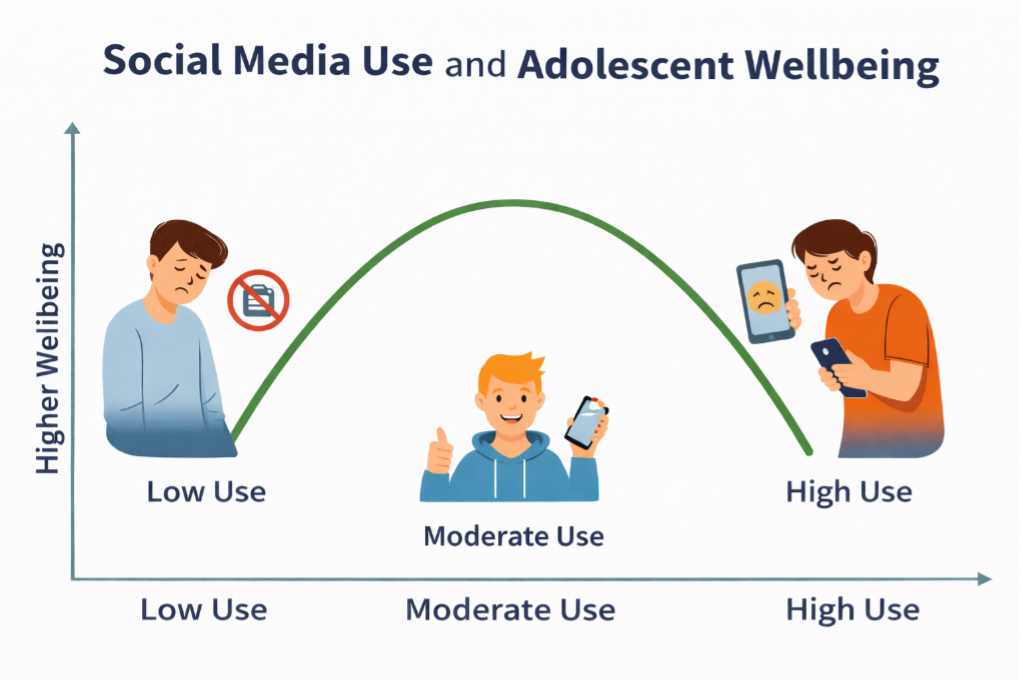
We found that the relationship isn’t simple. Teens who used social media moderately tended to have the best wellbeing overall, while both heavy use and complete non-use were linked with poorer outcomes. This “middle ground” pattern was consistent across several wellbeing indicators. Importantly, the associations differed by age and sex. For example, moderate use became increasingly beneficial during mid-to-late adolescence, when social media often plays a stronger role in peer connection, identity development, and maintaining friendships.
Figure 1 illustrates how adolescent wellbeing risk changes across school grades, comparing patterns among young people with no social media use, moderate use, and heavy use.
Figure 1 illustrates how adolescent wellbeing risk changes across school grades, comparing patterns among young people with no social media use, moderate use, and heavy use.
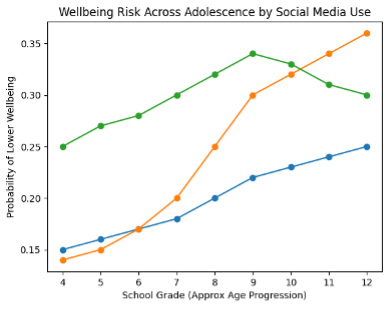
For younger adolescents, particularly girls, little or no social media use was sometimes associated with slightly better wellbeing. However, by later adolescence, complete non-use could also reflect social exclusion or reduced peer connection. At the other extreme, heavy use was consistently associated with poorer wellbeing, potentially reflecting issues such as social comparison, cyberbullying exposure, sleep disruption, or displacement of physical activity and face-to-face interaction.
Overall, the findings suggest social media is neither purely harmful nor purely beneficial. Its impact depends on context, developmental stage, purpose of use, and the balance between online and offline.
Why is it important?
Public conversations about social media often focus on restricting screen time, but our findings suggest the issue is more nuanced. Adolescence is a critical developmental period when peer connection, identity formation, and emotional regulation are rapidly evolving. Social media can support connection, self-expression, and access to information, but excessive use may increase risks such as emotional distress, sleep problems, sedentary behaviour, or reduced participation in physical activity.
A key strength of this study is its scale and longitudinal design. By following a very large cohort across several years and spanning the full adolescent age range, we were able to identify developmental patterns that smaller or cross-sectional studies often miss. This provides a more realistic picture of how social media fits into young people’s lives over time.
These insights are particularly timely given global concerns about youth mental health, physical inactivity, and digital technology use. Rather than adopting blanket restrictions, a more balanced approach may be needed — one that promotes healthy digital habits alongside active lifestyles, sleep, face-to-face social interaction, and supportive school and family environments.
For public health practitioners, educators, and policymakers, this means shifting the focus from “screen time reduction” alone toward helping young people develop digital resilience, critical thinking, and balanced daily routines that include physical activity, social connection, and wellbeing-supportive behaviours.
Take home messages
- Moderate social media use is often linked with better adolescent wellbeing than either heavy use or total abstinence.
- The impact of social media changes with age, sex, and developmental stage.
- Public health guidance should focus on balanced, healthy digital habits alongside physical activity and real-world social connection.
Authored by: Ben Singh, Mason Zhou, Rachel Curtis, Carol Maher, & Dorothea Dumuid | Alliance for Research in Exercise, Nutrition, and Activity (ARENA), Adelaide University, Adelaide, South Australia, Australia.