English
  العربية
  简体中文
简体中文  Français
  Deutsch (Sie)
  Русский
  Español
How a shift to movement‑centred pedagogy can strengthen research–practice alignment and improve sustainability in schools.
What is it about?
In recent years, physically active learning (PAL) has gained considerable attention for its potential to enhance both health and educational outcomes. Yet, despite strong supporting evidence, there are many challenges to broaden uptake in schools. These challenges often include time constraints, a supportive school climate, and resource availability. Concurrently, some scholars also underscore that integration has been researcher-driven, with a strong emphasis on health parameters, which can undermine teachers and their contexts. To address these challenges, a growing body of research suggests that successful integration and sustainment of PAL requires teachers to have sufficient competence and capability to enact PAL into their everyday practice.
Consequently, several projects have thus shifted attention from short training courses to more systematic efforts to build teachers’ capability. Central to the success of building systemic efforts is facilitating collaboration among policymakers, researchers, and teachers. However, this may be challenging, as PAL is perceived, operationalised, and prioritised differently across stakeholders. One possible explanation for why PAL continues to struggle to become a sustainable practice in schools is thus the way it is framed.
To overcome these challenges, we have proposed reframing PAL as a movement-centred pedagogy (MCP), as it represents a more holistic term that encompasses broader movement, pedagogy, and educational purposes.
What is movement-centred pedagogy?
- Movement = progress beyond the narrow vision of minutes of moderate to vigorous physical activity to reflect a broader appreciation of physical activity.
- Centred = Reflects the purpose of the movement and its role in providing a connection with the subject content.
- Pedagogy = Reflects a wider conception of the teaching-learning process in education that includes teachers’ choices and judgements about how, why, where, and when to integrate movement into teaching.
Reframing PAL as MCP offers a broader, more educationally grounded way to include physical activity as an integral part of teaching and learning (Figure 1). Turning attention towards pedagogical judgements can empower teachers to exercise their agency and utilise movement in teaching in ways that are coherent, accessible, and sustainable in real classroom settings. Rather than an ‘add-on’, MCP is intended to represent a deeper and seamless integration. Importantly, MCP offers a term that can strengthen the field’s pedagogical underpinnings and promote a more coherent synthesis of health and educational perspectives. Such a development towards the deeper appreciation of physical activity mirrors developments in the broader field. For these reasons, attending to MCP can represent more than a semantic shift. It can influence stakeholders to prioritise and engage more broadly with movement and education.
Why is it important?
PAL is distinct as it has evolved from a need to balance competing interests between academic pursuits and time spent on physical activity. As such, previous research has often positioned PAL as a health initiative embedded within education to promote learning outcomes. Although this has contributed valuable evidence, its narrow conception may have limited broader educational purposes and opportunities.
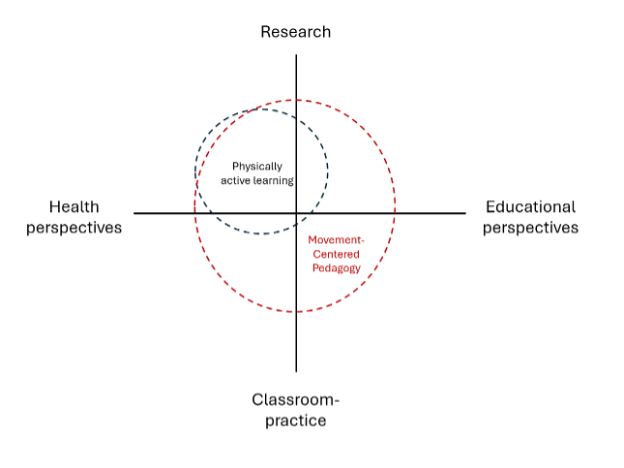
Reframing the concept as MCP matters because it positions movement as pedagogy, rather than as interventions. This means that movement is not simply treated as a mechanism for increasing physical activity and learning, but a catalyst for pupils’ growth, engagement, and well-being. Positioning movement as a starting point for teachers’ daily work provides a more flexible, pedagogically meaningful concept that can strengthen the connection between research and classroom practice. Moreover, teachers are more likely to integrate, adopt, and sustain it. The reframing of PAL as MCP is important because it shows that changing the language can change practice, support co-creation, and increase context-sensitivity. MCP aligns strongly with ISPAH’s Whole-School programs investment. It shifts movement from being an ‘add-on initiative’ to becoming embedded in everyday teaching practice, supporting sustainable, system-level change rather than short-term projects.
Take home messages
- Framing can impact how movement in schools is integrated, adapted, and sustained.
- Framing can inform, set boundaries and define a concept. This may impact which stakeholders intervene and engage with the problems and solutions.
- Moving from “physically active learning” to “movement-centred pedagogy” may increase teacher ownership, agency and autonomy.
- Embedding movement within teaching, rather than adding it on, supports whole-school change
Authored by: Mathias Mandelid1 & Anna Chalkley2
1 Western Norway University of Applied Sciences
2 University of Bradford