English
  العربية
  简体中文
简体中文  Français
  Deutsch (Sie)
  Русский
  Español
A global consensus on terminology to discuss the 24-hour cycle of physical activity, sedentary behaviour, and sleep.
What is the Around the Clock Terminology Consortium?
Physical activity, sedentary behavior, and sleep occupy most of the 24-hour cycle and are associated with a multitude of health outcomes. As this field of research rapidly increases, a key question emerges: what should we collectively call these behaviors? In September 2024, we established the Around the Clock Terminology Consortium (ACT-C) – an internationally representative group of researchers and key interest-holder organizations to develop a consensus in terminology for the 24-hour cycle of physical activity, sedentary behavior, and sleep (https://aroundtheclock.med.ubc.ca/team/).
Why do we need a consensus?
There is a looming “24-hour Babel”. In 2021, we highlighted that there were at least five separate terms used by researchers when referring to physical activity, sedentary behavior, and sleep collectively (e.g., movement behaviors, physical behaviors, or the 24-hour activity cycle) (https://bjsm.bmj.com/content/56/7/367.long). As more scientists enter this field, the terminology is becoming increasingly inconsistent and confusing. The time is now to develop a consensus.
Achieving consensus the right way
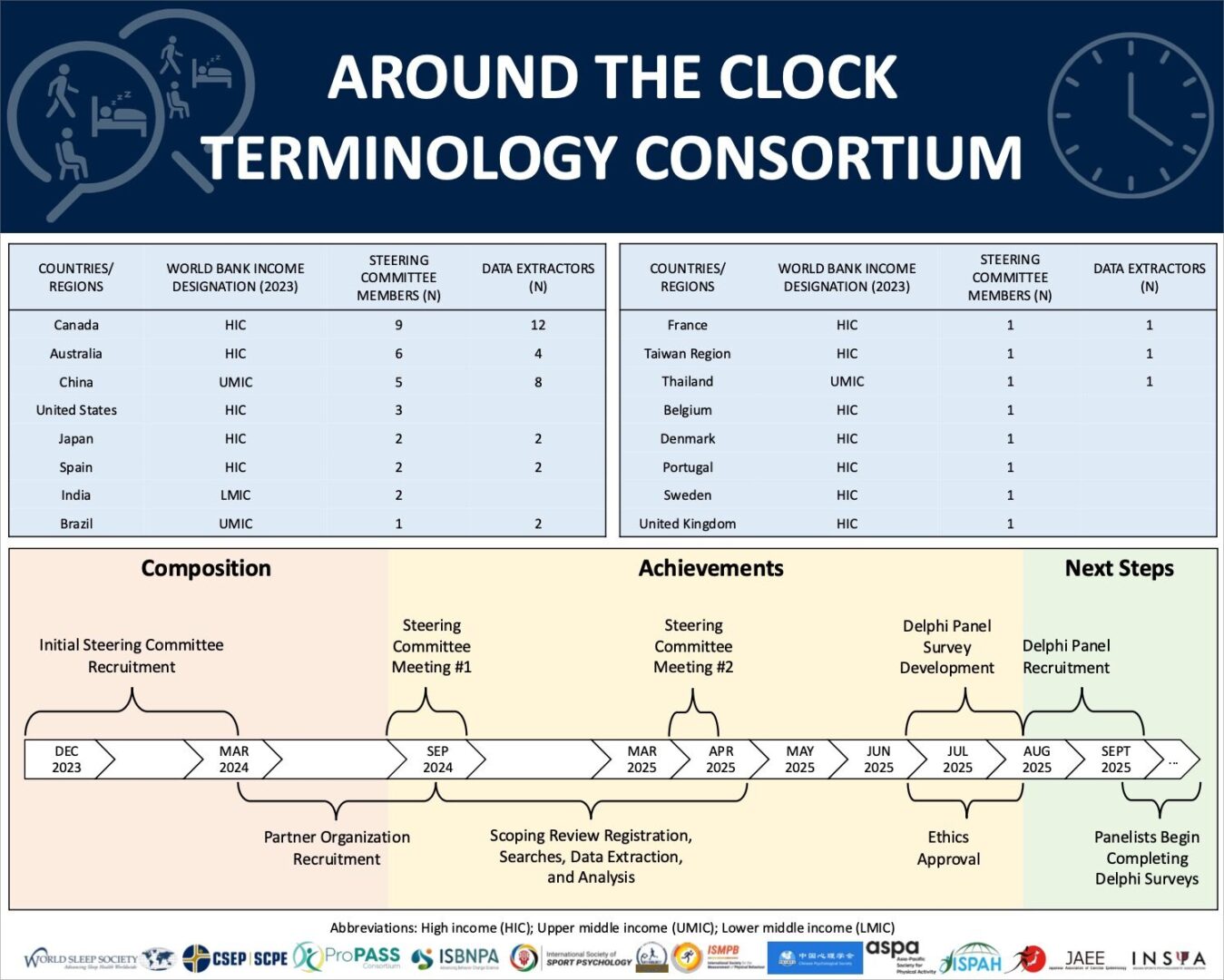
However, consensus statements are prone to bias (https://bjsm.bmj.com/content/bjsports/56/6/306.full.pdf). For example, they are often male dominated, rely on a narrow definition of ‘expert’, lack representation from developing and lower income countries, and often do not conduct a review of the literature to identify the knowledge gaps. The lack of consideration for equity, diversity, and inclusion in previous consensus-building projects motivated ACT-C to pursue an inclusive, representative, and international consensus regarding terminology for physical activity, sedentary behavior, and sleep (See Figure 1).
Current progress
We have partnered with 12 different national and international scientific interest-holding societies, including: 1) International Society of Physical Activity and Health (https://ispah.tecology-hosting.co); 2) International Society of Behavioral Nutrition and Physical Activity (https://isbnpa.org); 3) World Sleep Society (https://worldsleepsociety.org); and 4) International Society for the Measurement of Physical Behavior (https://ismpb.org), among others. As a means of ensuring that we have a clear identification of the knowledge gaps, we have conducted a 979-article scoping review which examines the current terminology used to describe physical activity, sedentary behavior, and sleep over the 24-hour day. We aim to publish this review in 2025.
Next steps
As we analyze the data from the scoping review, we are now conducting our Delphi consensus which has recently been approved by the University of British Columbia’s Behavioral Research Ethics Board (H25-02045) in August 2025. We are currently recruiting expert panelists for our Delphi panel, and as with the formation of our steering committee, we are adopting a multi-pronged approach to ensure a diverse and inclusive representation. Our Delphi panel survey questions will be informed by the results of our scoping review.
Summary
We have outlined our progress and plans to address the current lack of clear terminology for discussing the 24-hour day through an inclusive, international, and systematic process. ACT-C will establish internationally agreed-upon terminology for discussing the 24-hour cycle of physical activity, sedentary behavior, and sleep. For more information about our ongoing project, news, and results, please visit our website: https://aroundtheclock.med.ubc.ca.
Messages à emporter
- Clear, concise, and consistent language is fundamental for effective international scientific communication.
- The Around the Clock Terminology Consortium is dedicated to developing clear terminology for discussing the 24-hour cycle of physical activity, sedentary behavior, and sleep
- We are currently conducting a consensus to achieve internationally agreed upon terminology for the 24-hour day
Authorship, Declarations, Affiliations, Keywords
- Titles, first name, last names & numbered affiliations (separate with semi-colon)
| Title (e.g. Dr) | First name | Last name | Numbered affiliation | Competing interests (if none, please say “I have no relevant competing interests to declare”) |
| Dr | Ryan | Falck | 1 | I have no relevant competing interests to declare |
| Dr | Sjaan | Gomersall | 2 | I have no relevant competing interests to declare |
| Dr | Jasper | Schipperijn | 3 | I have no relevant competing interests to declare |
| Dr | Kirk | Erickson | 4 | I have no relevant competing interests to declare |
| Dr | Ester | Cerin | 5 | I have no relevant competing interests to declare |
| Dr | Liye | Zou | 6 | I have no relevant competing interests to declare |
| Dr | Ashleigh | Smith | 7 | I have no relevant competing interests to declare |
| Dr | Francisco | Ortega | 8 | I have no relevant competing interests to declare |
| Dr | Jennifer | Davis | 9 | I have no relevant competing interests to declare |
| Dr | Jannique | Van Uffelen | 10 | I have no relevant competing interests to declare |
| Dr | António | Palmeira | 11 | I have no relevant competing interests to declare |
| Dr | Michelle | Voss | 12 | I have no relevant competing interests to declare |
| Dr | David | Dunstan | 13 | I have no relevant competing interests to declare |
| Dr | Linda | Li | 14 | I have no relevant competing interests to declare |
| Dr | Jairo | Migueles | 15 | I have no relevant competing interests to declare |
| Dr | Nucharapon | Liangruenrom | 16 | I have no relevant competing interests to declare |
| Dr | Guilherme Moraes | Balbim | 17 | I have no relevant competing interests to declare |
| Dr | Jennifer | Tomasone | 18 | I have no relevant competing interests to declare |
| Dr | Matthew | Ahmadi | 19 | I have no relevant competing interests to declare |
| Dr | Karen | Spruyt | 20 | I have no relevant competing interests to declare |
| Dr | Frank Hookin | Fu | 21 | I have no relevant competing interests to declare |
| Dr | Lora | Giangregorio | 22 | I have no relevant competing interests to declare |
| Dr | Zhaowei | Kong | 23 | I have no relevant competing interests to declare |
| Dr | Jean-Philippe | Chaput | 24 | I have no relevant competing interests to declare |
| Dr | Miao | Miao | 25 | I have no relevant competing interests to declare |
| Dr | Natan | Feter | 26 | I have no relevant competing interests to declare |
| Ms | Keerthana | Swaminathan | 27 | I have no relevant competing interests to declare |
| Dr | Robert | Schinke | 28 | I have no relevant competing interests to declare |
| Dr | Yiqun | Gan | 29 | I have no relevant competing interests to declare |
| Dr | Shigeru | Inoue | 30 | I have no relevant competing interests to declare |
| Ms | Varadyini | Gorhe | 31 | I have no relevant competing interests to declare |
| Dr | Takumi | Abe | 32 | I have no relevant competing interests to declare |
| Ms | Maurelle | D’Sa | 33 | I have no relevant competing interests to declare |
| Dr | Yu-Kai | Chang | 34 | I have no relevant competing interests to declare |
| Dr | Amy Shirong | Lu | 35 | I have no relevant competing interests to declare |
| Dr | David | Lubans | 36 | I have no relevant competing interests to declare |
| Dr | Åsa | Tornberg | 37 | I have no relevant competing interests to declare |
| Dr | Teresa | Liu-Ambrose | 38 | I have no relevant competing interests to declare |
- Numbered affiliations (separate with semi-colon):
| Number | Affiliation |
| 1 | University of British Columbia, Faculty of Medicine, School of Biomedical Engineering, Centre for Aging SMART at the Vancouver Coastal Health Research Institute, Vancouver, BC, Canada |
| 2 | The University of Queensland, School of Human Movement and Nutrition Sciences, Health and Wellbeing Centre for Research Innovation, Brisbane, QLD, Australia |
| 3 | University of Southern Denmark, Department of Sports Science and Clinical Biomechanics, Odense, Denmark |
| 4 | AdventHealth Research Institute, Neuroscience Institute, Orlando, FL, United States of America |
| 5 | Australian Catholic University-Melbourne Campus, Mary Mackillop Institute for Health Research, Behaviour, Environment and Cognition Research Program, Melbourne, VIC, Australia School of Public Health, The University of Hong Kong, Hong Kong SAR, China |
| 6 | Body-Brain-Mind Laboratory, Shenzhen University, School of Psychology, Shenzhen, Guangdong Province, China |
| 7 | University of South Australia, Alliance for Research in Exercise, Nutrition and Activity (ARENA) Research Centre, Adelaide, SA, Australia |
| 8 | University of Granada, Department of Physical Education and Sports, Faculty of Sport Sciences, Sport and Health University Research Institute (iMUDS); and CIBEROBN Physiopathology of Obesity and Nutrition; Granada, Spain |
| 9 | University of British Columbia-Okangan Campus, Faculty of Management, Applied Health Economics Laboratory, Kelowna, BC, Canada |
| 10 | KU Leuven, Department of Movement Sciences, Physical Activity, Sports & Health Research Group, Leuven, Belgium & Leuven Brain Institute , KU Leuven, Leuven, Belgium |
| 11 | CIDEFES, Universidade Lusófona, Lisbon, Portugal CIFI2D, Universidade do Porto, Porto, Portugal |
| 12 | The University of Iowa, Iowa Neuroscience Institute, Department of Psychological and Brain Sciences, Iowa City, IA, United States of America |
| 13 | Institute for Physical Activity and Nutrition, Deakin University, Burwood, Australia Baker Heart and Diabetes Institute, Melbourne, Australia |
| 14 | University of British Columbia, Faculty of Medicine, Department of Physical Therapy, Arthritis Research Centre, Vancouver, BC, Canada |
| 15 | University of Granada, Department of Physical Education and Sports, Faculty of Sports Sciences, Sport and Health University Research institute (iMUDS), Granada, Spain |
| 16 | Mahidol University, Institute for Population and Social Research, Salaya, Thailand |
| 17 | University of British Columbia, Faculty of Medicine, Department of Physical Therapy, Aging, Mobility, and Cognitive Health Laboratory, Centre for Aging SMART at Vancouver Coastal Health Research Institute, Vancouver, BC, Canada |
| 18 | Queen’s University, School of Kinesiology and Health Studies, Revved Up Group, Kingston, ON, Canada |
| 19 | Mackenzie Wearables Research Hub, Charles Perkins Centre and School of Health Sciences, Faculty of Medicine and Health, University of Sydney, Sydney, NSW, Australia |
| 20 | Université de Paris, INSERM, NeuroDiderot, Paris, France |
| 21 | Hong Kong Baptist University, Faculty of Arts and Social Sciences, Department of Sport, Physical Education and Health, Dr. Stephen Hui Research Centre for Physical Recreation and Wellness, Hong Kong |
| 22 | University of Waterloo, Department of Kinesiology and Health Sciences, Waterloo, ON, Canada |
| 23 | University of Macau, Faculty of Education, Macau, China |
| 24 | Healthy Active Living and Obesity Research Group, Children’s Hospital of Eastern Ontario Research Institute, and Department of Pediatrics, University of Ottawa, Ottawa, ON, Canada |
| 25 | Peking University, School of Health Humanities, Department of Medical Psychology, Beijing, China |
| 26 | Federal University of Rio Grande do Sul, School of Medicine, Graduate Program in Epidemiology, Porto Alegre, RS, Brazil |
| 27 | The Performance Doctor, Chennai, India, INSPA Sport Psychologist’ Association, Manipal Academy of Higher Education, Manipal, Karnataka, India, University of Staffordshire, U.K |
| 28 | Laurentian University, Faculty of Education and Health, School of Kinesiology and Health Sciences, Sudbury, ON, Canada |
| 29 | Peking University, School of Psychological and Cognitive Sciences, Beijing, China |
| 30 | Tokyo Medical University, Department of Preventive Medicine and Public Health, Tokyo, Japan |
| 31 | MindFirst Performance Psychology, Pune, India, INSPA Sport Psychologists’ Association |
| 32 | School of Commerce, Meiji University, Tokyo, Japan |
| 33 | Department of Social Work and Wellbeing, Faculty of Health, Social Care and Medicine, Edge Hill University, Ormskirk, Lancashire, UK |
| 34 | National Taiwan Normal University, Department of Physical Education and Sport Sciences, Taipei, Taiwan |
| 35 | Northeastern University, Department of Communication Studies, College of Arts, Media, and Design, Department of Public Health & Health Sciences, Bouvé College of Health Sciences, Health Technology Lab, Boston, MA, United States of America |
| 36 | Centre for Active Living and Learning, College of Human and Social Futures, University of Newcastle, Callaghan, New South Wales, Australia Hunter Medical Research Institute, New Lambton Heights, New South Wales, Australia Faculty of Sport and Health Sciences, University of Jyväskylä, Jyväskylä, Finland |
| 37 | Lund University, Faculty of Medicine, Department of Health Sciences, Sweden |
| 38 | University of British Columbia, Faculty of Medicine, Department of Physical Therapy, Aging, Mobility, and Cognitive Health Laboratory, Centre for Aging SMART at Vancouver Coastal Health Research Institute, Vancouver, BC, Canada |